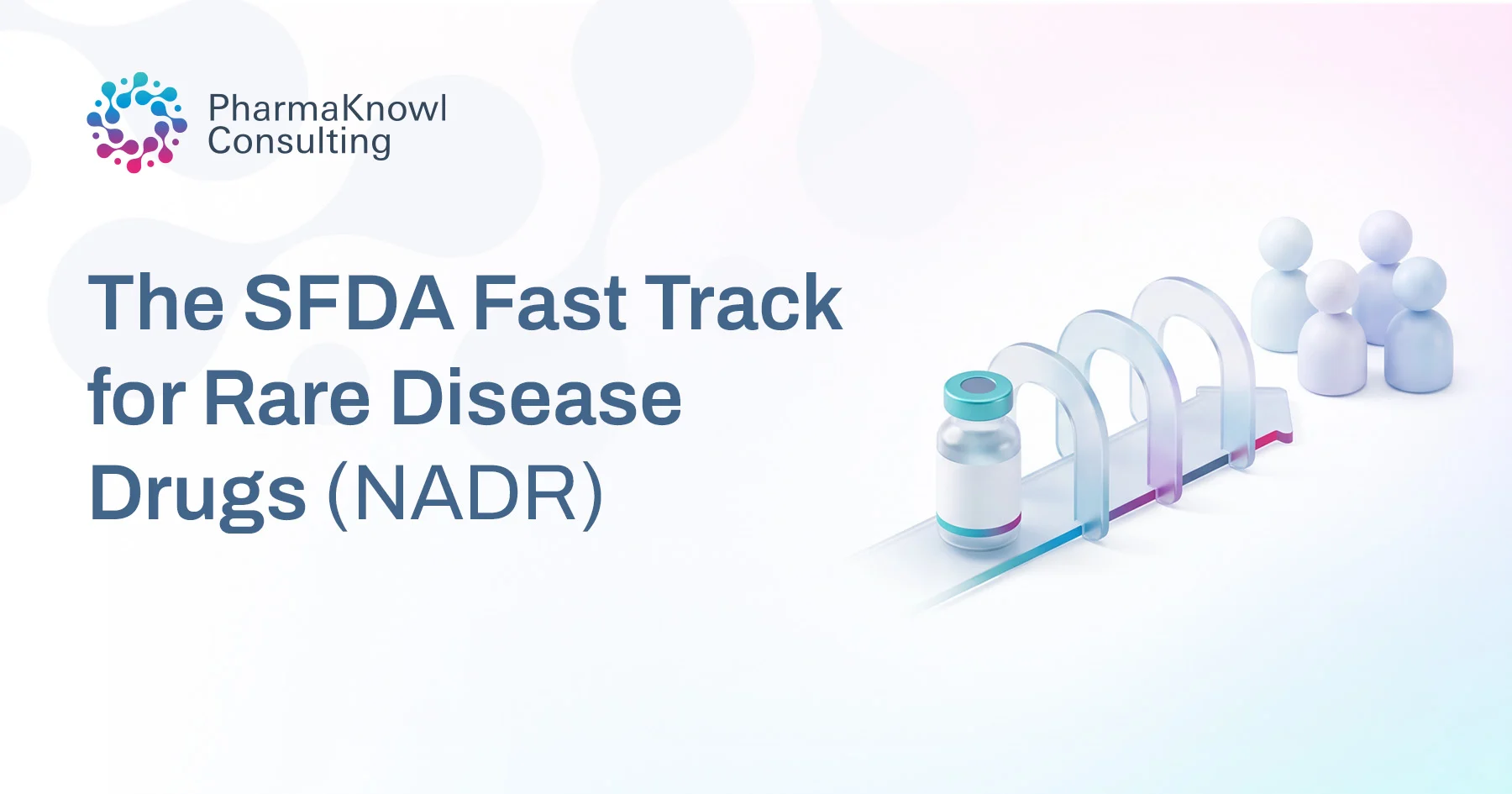
Rare diseases represent a significant public health challenge yet remain an underserved sector due to their low prevalence. In recognition of this gap, the Saudi Food and Drug Authority (SFDA) has developed a New Accelerator Program for Drugs for Rare Diseases (NADR), one of the accelerated pathways available in Saudi Arabia for pharmaceuticals and biologics. It is an enhanced regulatory track that facilitates earlier access to innovative medicines for patients with serious or life-threatening diseases or health conditions.
In this article, we will discuss the existing accelerated programs, NADR eligibility criteria, incentives, exemptions, and methodologies.
Table of content
- What is considered a rare disease in Saudi Arabia?
- NADR Eligibility
- NADR Incentives
- When can a NADR application be submitted?
- How to apply for NADR?
What is considered a rare disease in Saudi Arabia?
Worldwide, approximately 350 million people are suffering from more than 10,000 types of rare diseases. The highest prevalence, estimated at about 370,000 people, is in the Middle East and African regions. In Saudi Arabia, if the disease affects fewer than 1 in 2000 people in the community, it is considered rare.
According to the published evidence from Saudi Arabia, 80% of diseases have a genetic cause, and they occur more often in populations with high rates of intermarriage among blood relatives. Almost 70% are present in childhood, and 30% of children die from these rare diseases before the age of 5; hence, the most accurate diagnosis can be made at the age of 5 years. It has also been observed that 95% of treatment options yield unsatisfactory results.
According to the Saudi Ministry of Health 2024, due to limited treatment options, delayed diagnosis, and insufficient health support, the severity of the diseases and the quality of life are consequently affected.
NADR Eligibility
The New Accelerator program for Drugs for Rare Diseases is specifically intended for products targeting rare diseases with unmet medical needs. SFDA mandates that a drug meet all of the following eligibility criteria to qualify for the NADR program.
- Orphan condition: The disease affects fewer than 5 out of 10,000 individuals in Saudi Arabia, and the product is intended to prevent or treat a rare, life-threatening, or seriously debilitating disease. Read: Orphan Designation.
- Unmet medical need: Either no satisfactory treatment exists in Saudi Arabia, or the product offers significant clinical benefit, such as improved safety, efficacy, or patient outcomes, over currently available therapeutic options.
- Drug Status: The product may be under active development at any stage (from preclinical through Phase III) or already authorized by a regulatory authority but not yet registered in Saudi Arabia for the proposed indication.
NADR Incentives
Drugs enrolled in this program will receive benefits during development and submission. The SFDA provides the following incentives:
Regulatory
SFDA offers acceleration options, including conditional approval (rolling submission), priority review, and scientific advice, to help applicants align their development strategies with the drug registration requirements. In addition, SFDA assigns a dedicated Product Manager (PM) to guide applicants through formal meetings during product development.
Clinical
In clinical trials, because Randomized Controlled Trials (RCTs) are not feasible or ethical for rare diseases, SFDA accepts broader evidence for rare disease submissions, based on adaptive and innovative evidence-generation methodologies, including:
- Novel and advanced trials including Bayesian adaptive, N-of-1, basket, umbrella, and platform trials.
- Natural history study data showing disease progression in patients who receive no investigational treatment may be used as an external comparator/control group.
- New Approach Methodologies (NAMs), including Artificial Intelligence/Machine Learning and In Silico Modeling.
- Modeling and simulation outputs (such as Pharmacokinetics/Pharmacodynamics, physiologically based pharmacokinetic (PBPK), Dose-Response, Quantitative systems pharmacology (QSP), etc. must meet ICH M-15 requirements.
- Surrogate/Biomarker Endpoint Framework is acceptable in clinical settings for rare diseases for primary efficacy estimation.
- Platform Technology: Existing knowledge from an established technology can be reused to support new medicines using the same platform, reducing duplication of data generation, particularly for ultra-rare diseases.
- Saudi genomic data may be used for precise disease characterization.
- Risk-based Nonclinical Safety Requirements with robust post-approval monitoring obligations are accepted. SFDA decides on a case-by-case basis.
CMC
This incentive offers a flexible, science- and risk-based approach to Chemistry, Manufacturing, and Controls (CMC) data requirements when product quality is scientifically justified and can be adequately assured at the time of approval. By providing supporting data, the applicant may request exemptions from certain CMC requirements in Module 3 of the marketing authorization application. SFDA reviews these requests and responds within 20 working days if the documentation is complete.
GMP
If the product site is not yet an SFDA GMP-registered site, but located in one of the following countries: USA, UK, Canada, Australia, Japan, Switzerland, Germany, France, Ireland, Italy, Spain, Portugal, Finland, Sweden, Norway, Denmark, Belgium, Netherlands, Austria or Singapore, site inspection will not be a barrier to product registration. If an on-site inspection is required, then priority will be provided.
Pharmacovigilance
SFDA will adjust Periodic Safety Update Report (PSUR) and registry requirements based on patient population size to make them easier to meet and support compliance.
When can a NADR application be submitted?
The applicant may apply for NADR designation at any stage of the product’s development before submitting the marketing authorization application.
How to apply for NADR?
If you want an expert view on NADR and to secure incentives for this designation more quickly, we’re here to assist you. PharmaKnowl holds a significant share of approved designations with the SFDA, according to the authority’s published statistics during their workshops. Contact us or schedule a call with our team to discuss your case and explore the most efficient route to approval and patient access.
About the Author

Contributed by the PharmaKnowl regulatory affairs team, based in Riyadh. Written and reviewed by our SFDA-experienced consultants.
Resources
Services
Events