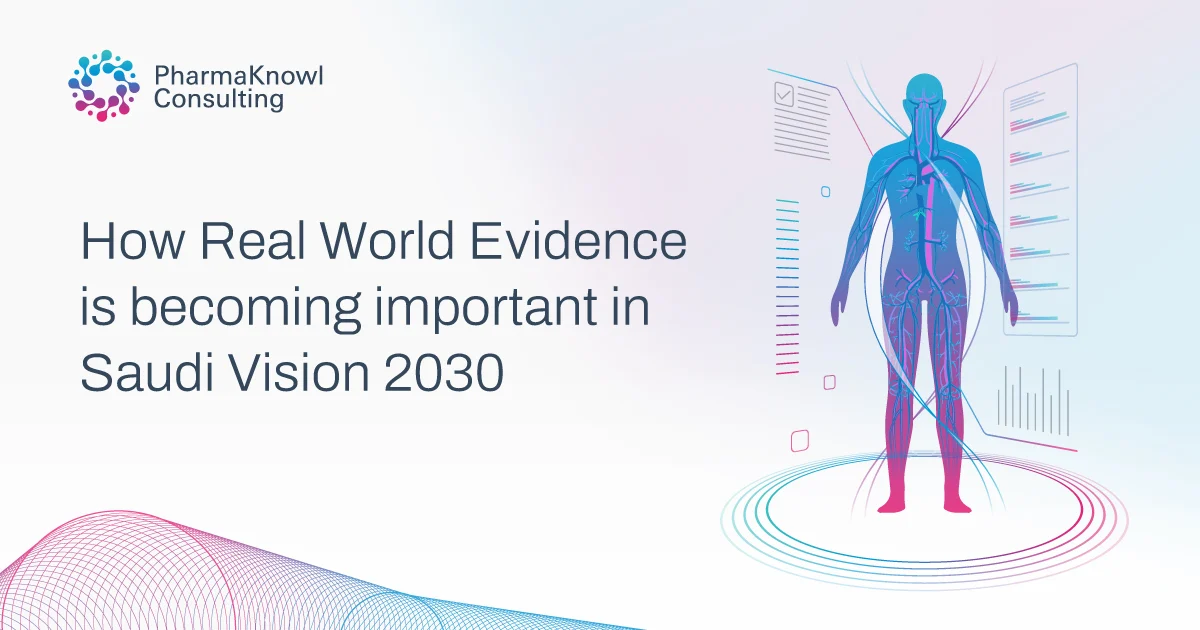
Saudi Food and Drug Authority (SFDA) is in continuous transformation to achieve a robust healthcare system in Saudi Arabia by ensuring the safety and effectiveness of medicinal products and/or vaccines; therefore, regulation and transformation of healthcare services and medical health record systems are one of the fourth strategic approaches considering the Saudi Vision 2030.
This article explores the key concepts about Real World Data (RWD) and Real-World Evidence (RWE) that will benefit all stakeholders, including pharmaceutical and biotechnology companies, healthcare providers, Clinical Research Organizations (CROs), researchers, sponsors, and life sciences companies.
Table of content
- RWD vs RWE
- Appropriate data sources of RWD
- Study Designs for RWE
- Why is RWE shaping modern healthcare?
- Understanding bias and confounding in RWE
- Use of RWD and RWE in making regulatory decisions
- How does it benefit stakeholders?
RWD vs RWE
RWD is collected from patients during routine healthcare services, reflecting their health conditions over time, providing accurate longitudinal information, and is considered fit-for-purpose Real World Data.
While RWE is generated by analyzing fit-for-purpose Real World Data to assess the effectiveness and safety of medicinal products or vaccines in routine clinical practice. These questions or analyses typically use estimands that precisely describe the treatment effect.
Appropriate data sources of RWD
- Electronic Health Records (EHR)
- Medical claims data
- Patient/disease registries
- Wearable devices
- Patient-Reported Outcomes (PRO)
Study Designs for RWE
| TYPES OF STUDIES | PURPOSE | EXAMPLES |
| Observational Studies | These non-interventional primary or secondary data studies provide high relevance and generalizability to routine clinical practice. | Cohort and Case-control studies |
| Target Trial Emulation | It increases the robustness of causal inferences and the clinical relevance of RWD findings. | Clinical questions or comparative effectiveness questions |
| Hybrid Trials | Collect data from traditional clinical trials and real-world evidence. | Electronic health records and medical claims |
| Pragmatic Trials | Assess the correlation between different interventions in a routine clinical setting. | Real-world clinical practice studies |
| Registry-Based Trials | Evaluate the safety or effectiveness of a treatment using data collected from an existing patient or disease registry. | SWEDEHEART-based TASTE trial (cardiac registry trial) |
Why is RWE shaping modern healthcare?
Traditional clinical trials remain the gold standard for establishing the safety and efficacy of medicinal products. However, randomized controlled trials (RCTs) are conducted under highly controlled conditions and often involve selected patient populations, which may not fully reflect how treatments are used in routine clinical practice. This gap is addressed by Real World Data (RWD) and Real-World Evidence (RWE), which provide insights into the effectiveness, safety, and utilization of medical products in real-world healthcare settings.
Common Data Models (CDMs) enable better quality control and provide uniform, consistent data across datasets.
Understanding bias and confounding in RWE
Confounding variables in clinical trials are commonly observed and may pose challenges, affecting the validity and limiting the interpretation of results from observational studies. This can be addressed through the choice of study designs and data analysis methods, such as stratification, standardization, regression models, propensity scores, and integration of machine learning tools with a high-dimensional propensity score (hdPS) method.
These biases may also arise from inappropriate data handling in generating RWE; however, they can be addressed through patient matching and target trial emulation.
Use of RWD and RWE in making regulatory decisions
1) Hypothesis Generation
- Using an approved drug to treat a different disease.
- Evaluating alternative strategies prior to a Randomized Clinical Trial (RCT) to inform clinical development decisions.
- Using genetic data from biobanks for drug discovery.
2) Supporting Single-Arm Studies through external controls
- RWD can enhance single-arm studies by providing an external comparator to the treatment arm.
- This is commonly used in early-phase trials and rare diseases with limited or no treatment options.
- Historical or external controls help strengthen evidence when randomized trials are not feasible.
- This approach is particularly relevant for orphan drug development or when trials may be unethical or impractical.
3) Significance of Data from Saudi Arabia
Since clinical trials are increasingly conducted as multi-regional studies with varying distributions of effect modifiers across regions, local real-world data can support the applicability of trial results to the target population by providing information on key baseline factors.
4) Providing prior information
RWD can be valuable in informing the assumptions used to optimize sample size, treatment dosage, or patient selection criteria.
5) Investigating minority populations in RCTs
RWE supports evaluation of research questions across broader, more inclusive populations.
How does it benefit stakeholders?
RWD and RWE provide value across all stakeholders by enabling faster, more efficient decision-making, strengthening evidence generation, and improving the relevance of clinical research to real-world practice. They support better study design, enhance regulatory and reimbursement submissions, and enable access to larger, more diverse populations, including rare and underrepresented groups. Overall, RWD and RWE bridge the gap between clinical trials and routine healthcare, leading to more generalizable and actionable insights.
Connect with us to see how PharmaKnowl’s CRO can transform your clinical development process in Saudi Arabia. Contact us
About the Author

Contributed by the PharmaKnowl regulatory affairs team, based in Riyadh. Written and reviewed by our SFDA-experienced consultants.
Resources
Services
Events