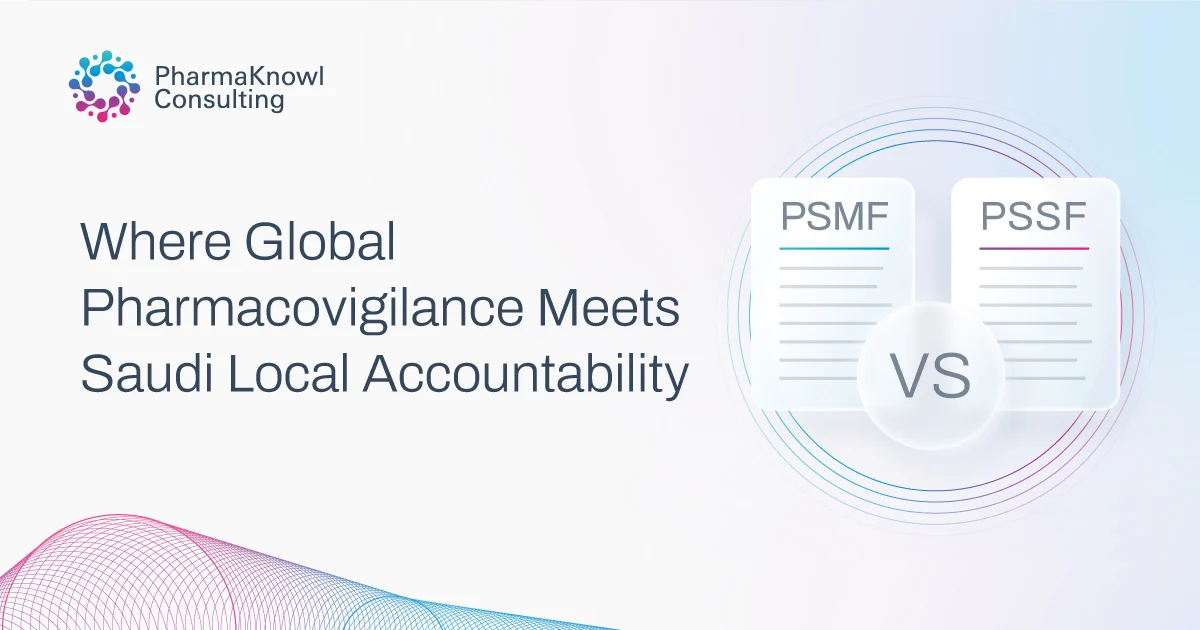
In pharmacovigilance, regulators increasingly expect companies to demonstrate how their global PV systems are implemented, governed, and controlled at the local level. This is especially relevant when comparing the European Union pharmacovigilance framework with the Saudi Food and Drug Authority expectations in Saudi Arabia.
One topic that often creates confusion is the relationship between two key documents:
- PSMF (Pharmacovigilance System Master File) &
- PSSF (Pharmacovigilance Subsystem File)
At first glance, they may appear to be completely different regulatory concepts. In practice, the difference is mainly about applicability, scope, and how the PV system is represented locally.
Table of Content
- Why does this matter?
- The Key Idea
- Who actually needs a PSSF in Saudi Arabia?
- EU perspective: The role of the PSMF
- What does the PSMF typically include?
- Strengths of the EU approach
- Saudi perspective: Local accountability in focus
- What does the PSSF demonstrate?
- Why does this matter during inspections?
- PSMF vs PSSF: Practical comparison
- Common gaps seen in practice
- A simple way to remember it
- Interactive checkpoint for PV professionals
Why does this matter?
Because misunderstanding PSMF and PSSF applicability can lead to:
- Incorrect documentation structures
- Misaligned PV systems
- Inspection observations
- Unnecessary operational complexity
The Key Idea
The PSSF in Saudi Arabia functions as the local Saudi representation of a global pharmacovigilance system. In the EU framework, there is no official document called a “PSSF.” The EU focuses on the Pharmacovigilance System Master File, which describes the MAH’s pharmacovigilance system and is expected to reflect it at global, regional, and local levels where relevant. Saudi Arabia formalizes the local perspective through the Pharmacovigilance Subsystem File, particularly for multinational MAHs operating through a global PV structure.
In simple terms, the PSMF explains the overall PV system. The PSSF explains how that system works in Saudi Arabia. That distinction may sound small, but in inspection readiness it can make a major difference. This is where many misunderstandings begin.
Who actually needs a PSSF in Saudi Arabia?
This is the most important question about applicability. A PSSF is not required for every company operating in Saudi Arabia. The requirement depends on whether the company operates as:
- As a global/multinational MAH, or
- As a local Saudi MAH
Scenario 1: Multinational or global MAHs
If a company:
- Has a global pharmacovigilance system outside Saudi Arabia
- Operates in Saudi directly or through a subcontractor/partner
- Uses a centralized global PV structure
Then the practical expectation is having a PSMF and a PSSF. In this structure:
- The PSMF describes the overall global PV system
- The PSSF explains how that global system functions specifically within Saudi Arabia
The PSSF therefore acts as:
- A localized extension of the global PSMF
- A Saudi-specific operational view of the PV system
Scenario 2: Local Saudi MAHs
If the company is:
- A local Saudi manufacturer or local MAH
- Operating only through a local PV system
- Without a larger global PV structure
Then the practical expectation is to have a PSMF only. A separate PSSF is not required, as there is no global parent PV system that requires Saudi-specific local adaptation. In this case, the PSMF itself must comprehensively describe all local PV activities.
This distinction helps prevent unnecessary documentation and keeps the PV system simpler, clearer, and more inspection-ready.
The role of the PSMF
The PSMF is a central document describing the pharmacovigilance system used by the Marketing Authorization Holder. It is not just a procedural document. It gives regulators visibility to:
- How the PV system operates
- Who is responsible for oversight
- How safety activities are managed
- How compliance is maintained
What does the PSMF typically include?
A standard PSMF generally contains information related to:
- Organizational structure
- QPPV responsibilities
- Safety databases and systems
- Case processing activities
- Signal management processes
- Risk management activities
- Vendor oversight
- Quality management system
- Audits, deviations, and CAPAs
- Training and compliance monitoring
The purpose is to provide regulators with a clear overview of the entire PV system.
Saudi perspective: Local accountability in focus
Saudi Arabia’s pharmacovigilance framework aligns with global standards while placing strong emphasis on local implementation, ownership, and oversight. For multinational MAHs, the key question is not only whether a global PV system exists, but whether the company can clearly demonstrate how that system operates in Saudi Arabia. This is exactly where the PSSF becomes important. It creates a country-specific view of responsibilities, processes, systems, partners, and compliance activities.
What does the PSSF demonstrate?
For multinational MAHs, the PSSF should clearly describe:
- Local PV organizational structure
- Local QPPV responsibilities
- Saudi reporting pathways
- Local adverse event handling processes
- Vendor and partner oversight within KSA
- Saudi-specific compliance activities
- Communication with SFDA
- Local implementation of global procedures
In practical terms, the PSSF answers one regulatory question: How is the global PV system functioning specifically in Saudi Arabia?
Why does this matter during SFDA inspections?
During inspections, SFDA often assesses whether:
- Global procedures are truly implemented locally
- Local teams understand their responsibilities
- Reporting timelines are followed within Saudi requirements
- Local oversight is effective and traceable
A well-maintained PSSF provides visibility into these activities. Without this clarity, even a strong global PSMF may not sufficiently demonstrate local compliance.
PSMF vs PSSF: Practical comparison
| Feature | PSMF (EU / Global) | PSSF (KSA – Global MAHs) | PSMF (Local Saudi MAH) |
| Scope | Entire global PV system applied to authorized products | Saudi-specific PV activities within the global PV framework | Entire local PV system operated in Saudi Arabia |
| Regulatory basis | EU GVP Module II and applicable EU PV legislation | SFDA GVP requirements for national PV subsystem documentation | SFDA GVP requirements for the MAH’s PV system |
| Applicability | EU MAHs and global systems supporting EU-authorised products | Multinational MAHs operating in Saudi Arabia through a global PV system | Local Saudi MAHs without a separate global parent PV system |
| Document nature | Master file describing the PV system | Local subsystem file linked to the global PSMF | Standalone master file for the local PV system |
| Purpose | Provide global system oversight and inspection visibility | Demonstrate how global PV processes are implemented locally in KSA | Demonstrate full local PV oversight and compliance |
| Ownership | MAH with QPPV oversight | Local MAH / local QPPV with alignment to global PV owner | Local MAH / local QPPV |
| Location and access | Maintained at the QPPV site or accessible as required | Maintained and accessible within Saudi Arabia | Maintained and accessible within Saudi Arabia |
| Relationship | Main/master PV system document | Local extension or country-specific representation of the global PSMF | Standalone master document for the local PV system |
| QPPV focus | QPPV responsibilities, authority, contact details, and oversight arrangements | Local QPPV responsibilities, authority, deputy/back-up arrangements, and Saudi oversight | Local QPPV responsibilities, authority, deputy/back-up arrangements, and full local oversight |
| Organizational structure | Global, regional, and local PV organization where relevant | Saudi local PV organization and interfaces with global teams, affiliates, distributors, and vendors | Local Saudi PV organization and reporting lines |
| Safety data sources | Global sources of safety information, including affiliates and partners | Saudi-specific sources such as local reports, distributors, medical information, digital channels, and partners | All local safety data sources used by the Saudi MAH |
| Systems and databases | Global safety databases and supporting computerized systems | Local access, data flow, interfaces, and use of global or local systems in Saudi Arabia | Systems and databases used for the local PV system |
| PV process coverage | ICSR management, signal management, risk management, aggregate reports, safety communication, and related PV processes | How these global processes are executed, escalated, documented, and tracked locally in KSA | How all PV processes are performed within the local Saudi system |
| Quality system | Global PV quality system, SOPs, audits, deviations, CAPAs, and compliance monitoring | Saudi-specific SOPs/WIs, local training, audit readiness, deviations, CAPAs, and vendor oversight | Local quality system, SOPs, training, audits, deviations, CAPAs, and compliance monitoring |
| Vendor/partner oversight | Global outsourcing model and contractual arrangements | Saudi distributors, local service providers, third parties, contracts, reconciliation, and oversight evidence | Local vendors and partners supporting the Saudi PV system |
| Product coverage | Products covered by the global PV system, including authorized products where applicable | Products marketed or authorized in Saudi Arabia under the global MAH structure | Products authorized and managed locally by the Saudi MAH |
| Inspection use | Allows inspectors to understand the overall PV system quickly | Shows whether local Saudi implementation matches the documented global system | Shows whether the local MAH has a complete and functioning PV system |
| Update triggers | Major changes to PV system, QPPV, systems, processes, products, vendors, or quality arrangements | Changes to local QPPV, local processes, Saudi vendors, reporting routes, systems access, products, or SFDA expectations | Changes to local structure, QPPV, products, systems, procedures, vendors, or quality arrangements |
| Common risk if weak | Global system appears incomplete, outdated, or not inspection-ready | Local Saudi practice is not traceable, not aligned, or not sufficiently documented | Local PV system appears fragmented or dependent on undocumented processes |
| Best-practice mindset | “Show the whole system.” | “Show how the system works in Saudi Arabia.” | “Show the complete local system.” |
Common gaps seen in practice
From a PV and QA perspective, most issues do not arise from missing documentation. They arise because documentation does not reflect reality.
Common examples include:
- PSMFs that describe processes not followed locally
- PSSFs copied from global templates without Saudi customization
- Local activities missing from the documented PV system
- Vendor oversight not clearly described
- Inconsistencies between procedures and actual practice
These gaps often become visible during:
- SFDA inspections
- Partner audits
- Internal audits
- Due diligence assessments
A simple way to remember it
A simple way to understand the relationship is:
- PSMF = the complete PV system overview
- PSSF = the Saudi operational view of that global system
However, if no global framework exists, the PSMF itself becomes the complete local PV system document. This is why local Saudi MAHs generally do not require a PSSF.
About the Author

Contributed by the PharmaKnowl regulatory affairs team, based in Riyadh. Written and reviewed by our SFDA-experienced consultants.
Resources

Services
Events