About the Author
Regulatory Editor
Published by regulatory affairs team in PharmaKnowl, Riyadh office.
The Electronic Common Technical Document (eCTD) has become a standard among regulatory submissions worldwide, ensuring Consistency, Transparency, and Efficiency. In Saudi Arabia, the Saudi Food and Drug Authority (SFDA) has carried out this mandate for all human drug applications since January 3, 2015, but it was in the CTD and NeeS formats years before that.
Companies filing with the SFDA must be familiar with the eCTD requirements (Modules 1–5) and the baseline submission process. This article briefly examines what SFDA wants and describes how baseline submissions become crucial in managing a dossier’s lifecycle.
Key Takeaways
- The eCTD requirements in SFDA have applied to all human drug applications, including pharmaceuticals and biologics, since 2010.
- Companies must convert all legacy formats (CTD, NeeS) to the eCTD format for submissions.
- Baseline submissions establish a clean starting point for lifecycle management without introducing new data.
- eCTD submissions must use Modules 1-5, with specific requirements for different drug types.
- The eCTD promotes consistency, transparency, and better regulatory tracking in Saudi Arabia.
Table of contents
When is eCTD applicable?
- It is mandatory for all human drug applications, including pharmaceuticals, biologicals, biosimilars, and generic drugs.
- Required for submissions for drug registrations, renewals, and variations.
- All old paper-based, CTD, and NeeS-formatted files must be converted to eCTD format.
General Principles
- All submissions must use eCTD dossiers with proper sequences throughout the product lifecycle management.
- The latest approved version of the technical Specifications accepted by the Gulf Cooperation Council (GCC) countries is version 1.5
- A single dossier typically covers all dosage forms, strengths, and pack sizes of a drug product.
- All dossier updates should use the appropriate operation attribute to reflect a change to a document.
- The exchange of communication is one-way in eCTD, from the company to the authority. The authorities send the inquiries out of the eCTD, and the applicants respond with a new eCTD sequence.
- The files in the eCTD dossier must be searchable and annotations enabled.
- Bookmarks and hyperlinking are encouraged where necessary without overuse.
- Once submitted in eCTD, the SFDA does not allow reverting to other formats.
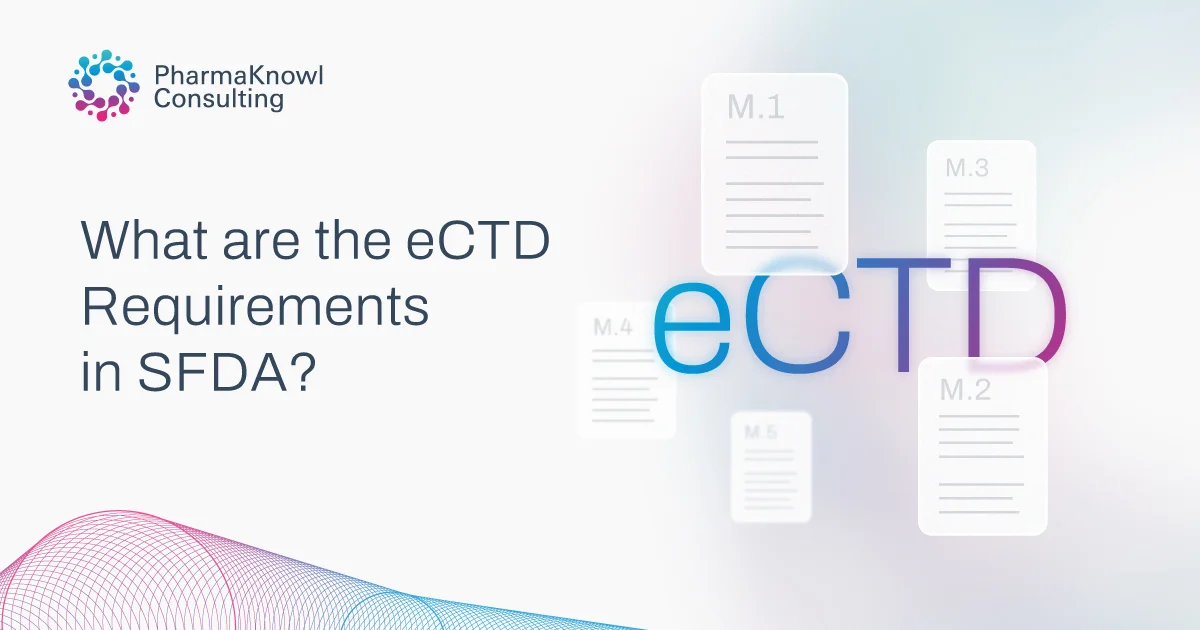
- Ideally, eCTD submissions shall cover Modules 1–5 (administrative, clinical, and quality information), unless it’s a generic drug, in which case only Modules M1, M2, and M3 are required.
eCTD Structure
SFDA adopted the ICH eCTD structure with regional variations. The table below presents a merged table that articulates requirements across all five modules. For the exact module one requirements for Saudi Arabia, you may refer to our downloadable file: (Checklist: SFDA Drug Dossier Requirements, which has additional comments for every section.
| Module 1: Regional Administrative Information | 1.0 | Cover Letter |
| 1.1 | Comprehensive Table of Contents | |
| 1.2 | SDR Application Form | |
| 1.3 | Product Information: SPC, Labeling, Arabic/English PILs, Artwork, Samples | |
| 1.4 | Information on Experts: Quality, Non-clinical, Clinical | |
| 1.5 | Environmental Risk Assessment: Non-GMO, GMO | |
| 1.6 | Pharmacovigilance: System & Risk Management Plan | |
| 1.7 | Certificates & Declarations: GMP, CPP, COAs (drug substance/product, excipients), Alcohol/Pork declarations, TSE, Patents, DMF access letters | |
| 1.8 | Pricing: Price List & Related Documents | |
| 1.9 | Responses to Questions | |
| Mdule 2: CTD Summaries | 2.1 | TOC of Modules 2–5 |
| 2.2 | Introduction | |
| 2.3 | Quality Overall Summary (Drug Substance & Product) | |
| 2.4 | Non-clinical Overview | |
| 2.5 | Clinical Overview: Development rationale, efficacy, safety, benefit–risk | |
| 2.6 | Non-clinical Summaries: Pharmacology, Pharmacokinetics, Toxicology | |
| 2.7 | Clinical Summary: Biopharmaceutics, PK/PD, Efficacy, Safety, Synopses | |
| Module 3: Quality | 3.1 | TOC of Module 3 |
| 3.2.S | Drug Substance: Manufacture, Controls, Characterization, Stability | |
| 3.2.P | Drug Product: Development, Manufacturing, Specifications, Stability | |
| 3.2.A | Appendices: Facilities, Adventitious Agents, Novel Excipients | |
| 3.2.R | Regional Information | |
| 3.3 | Literature References | |
| Module 4: Non-Clinical Study Reports | 4.1 | TOC of Module 4 |
| 4.2 | Study Reports: Pharmacology, Pharmacokinetics (ADME), Toxicology | |
| 4.3 | Literature References | |
| Module 5: Clinical Study Reports | 5.1 | TOC of Module 5 |
| 5.2 | Tabular Listing of Clinical Studies | |
| 5.3 | Clinical Study Reports: Biopharmaceutics, Human PK/PD, Efficacy, Safety, Post-marketing | |
| 5.4 | Literature References |
Baseline Submissions in eCTD
Baseline submission is the resubmission of the latest approved and valid documents in the eCTD format. The baseline sequence must not contain any new data and hence does not undergo scientific review by SFDA. Instead, it merely establishes a current dossier, a clean starting point for lifecycle management.
Baseline submissions are mandatory when moving from CTD or NeeS formats to eCTD and when aligning dossiers already under eCTD.
Why is it Important?
- It provides authorities, such as the SFDA, with a starting point for lifecycle management of eCTD.
- Ensures consistency and traceability for future submissions.
- Makes the change from CTD/NeeS to eCTD format easier.
Baseline Submission Scenarios
| Case | Sequence No. | Submission Description | Submission Type | Submission Unit | Related Sequence |
|---|---|---|---|---|---|
| NeeS/CTD to eCTD | 0000 | Baseline Submission | None | Reformat | – |
| 0001 | Variation | var-type2 | – | 0000 | |
| 0002 | Response to Questions | var-type2 response | – | 0001 |
Conclusion
The adoption of the eCTD by SFDA has brought about the modernization of regulatory submissions in Saudi Arabia. Allowing easy tracking and the accumulation of changes and regulatory cycles within a single, connected file asset. Companies and regulatory professionals can also use a single database or quality system to track historical changes to their products.
Read More
The Electronic Common Technical Document (eCTD) has become a standard among regulatory submissions worldwide, ensuring Consistency, Transparency, and Efficiency. In Saudi Arabia, the Saudi Food and Drug Authority (SFDA) has carried out this mandate for all human drug applications since January 3, 2015, but it was in the CTD and NeeS formats years before that.
Companies filing with the SFDA must be familiar with the eCTD requirements (Modules 1–5) and the baseline submission process. This article briefly examines what SFDA wants and describes how baseline submissions become crucial in managing a dossier’s lifecycle.
Key Takeaways
- The eCTD requirements in SFDA have applied to all human drug applications, including pharmaceuticals and biologics, since 2010.
- Companies must convert all legacy formats (CTD, NeeS) to the eCTD format for submissions.
- Baseline submissions establish a clean starting point for lifecycle management without introducing new data.
- eCTD submissions must use Modules 1-5, with specific requirements for different drug types.
- The eCTD promotes consistency, transparency, and better regulatory tracking in Saudi Arabia.
Table of contents
When is eCTD applicable?
- It is mandatory for all human drug applications, including pharmaceuticals, biologicals, biosimilars, and generic drugs.
- Required for submissions for drug registrations, renewals, and variations.
- All old paper-based, CTD, and NeeS-formatted files must be converted to eCTD format.
General Principles
- All submissions must use eCTD dossiers with proper sequences throughout the product lifecycle management.
- The latest approved version of the technical Specifications accepted by the Gulf Cooperation Council (GCC) countries is version 1.5
- A single dossier typically covers all dosage forms, strengths, and pack sizes of a drug product.
- All dossier updates should use the appropriate operation attribute to reflect a change to a document.
- The exchange of communication is one-way in eCTD, from the company to the authority. The authorities send the inquiries out of the eCTD, and the applicants respond with a new eCTD sequence.
- The files in the eCTD dossier must be searchable and annotations enabled.
- Bookmarks and hyperlinking are encouraged where necessary without overuse.
- Once submitted in eCTD, the SFDA does not allow reverting to other formats.
- Ideally, eCTD submissions shall cover Modules 1–5 (administrative, clinical, and quality information), unless it’s a generic drug, in which case only Modules M1, M2, and M3 are required.
eCTD Structure
SFDA adopted the ICH eCTD structure with regional variations. The table below presents a merged table that articulates requirements across all five modules. For the exact module one requirements for Saudi Arabia, you may refer to our downloadable file: (Checklist: SFDA Drug Dossier Requirements, which has additional comments for every section.
| Module 1: Regional Administrative Information | 1.0 | Cover Letter |
| 1.1 | Comprehensive Table of Contents | |
| 1.2 | SDR Application Form | |
| 1.3 | Product Information: SPC, Labeling, Arabic/English PILs, Artwork, Samples | |
| 1.4 | Information on Experts: Quality, Non-clinical, Clinical | |
| 1.5 | Environmental Risk Assessment: Non-GMO, GMO | |
| 1.6 | Pharmacovigilance: System & Risk Management Plan | |
| 1.7 | Certificates & Declarations: GMP, CPP, COAs (drug substance/product, excipients), Alcohol/Pork declarations, TSE, Patents, DMF access letters | |
| 1.8 | Pricing: Price List & Related Documents | |
| 1.9 | Responses to Questions | |
| Mdule 2: CTD Summaries | 2.1 | TOC of Modules 2–5 |
| 2.2 | Introduction | |
| 2.3 | Quality Overall Summary (Drug Substance & Product) | |
| 2.4 | Non-clinical Overview | |
| 2.5 | Clinical Overview: Development rationale, efficacy, safety, benefit–risk | |
| 2.6 | Non-clinical Summaries: Pharmacology, Pharmacokinetics, Toxicology | |
| 2.7 | Clinical Summary: Biopharmaceutics, PK/PD, Efficacy, Safety, Synopses | |
| Module 3: Quality | 3.1 | TOC of Module 3 |
| 3.2.S | Drug Substance: Manufacture, Controls, Characterization, Stability | |
| 3.2.P | Drug Product: Development, Manufacturing, Specifications, Stability | |
| 3.2.A | Appendices: Facilities, Adventitious Agents, Novel Excipients | |
| 3.2.R | Regional Information | |
| 3.3 | Literature References | |
| Module 4: Non-Clinical Study Reports | 4.1 | TOC of Module 4 |
| 4.2 | Study Reports: Pharmacology, Pharmacokinetics (ADME), Toxicology | |
| 4.3 | Literature References | |
| Module 5: Clinical Study Reports | 5.1 | TOC of Module 5 |
| 5.2 | Tabular Listing of Clinical Studies | |
| 5.3 | Clinical Study Reports: Biopharmaceutics, Human PK/PD, Efficacy, Safety, Post-marketing | |
| 5.4 | Literature References |
Baseline Submissions in eCTD
Baseline submission is the resubmission of the latest approved and valid documents in the eCTD format. The baseline sequence must not contain any new data and hence does not undergo scientific review by SFDA. Instead, it merely establishes a current dossier, a clean starting point for lifecycle management.
Baseline submissions are mandatory when moving from CTD or NeeS formats to eCTD and when aligning dossiers already under eCTD.
Why is it Important?
- It provides authorities, such as the SFDA, with a starting point for lifecycle management of eCTD.
- Ensures consistency and traceability for future submissions.
- Makes the change from CTD/NeeS to eCTD format easier.
Baseline Submission Scenarios
| Case | Sequence No. | Submission Description | Submission Type | Submission Unit | Related Sequence |
|---|---|---|---|---|---|
| NeeS/CTD to eCTD | 0000 | Baseline Submission | None | Reformat | – |
| 0001 | Variation | var-type2 | – | 0000 | |
| 0002 | Response to Questions | var-type2 response | – | 0001 |
Conclusion
The adoption of the eCTD by SFDA has brought about the modernization of regulatory submissions in Saudi Arabia. Allowing easy tracking and the accumulation of changes and regulatory cycles within a single, connected file asset. Companies and regulatory professionals can also use a single database or quality system to track historical changes to their products.
Read More
About the Author
Published by regulatory affairs team in PharmaKnowl, Riyadh office.
Resources
Services
Events