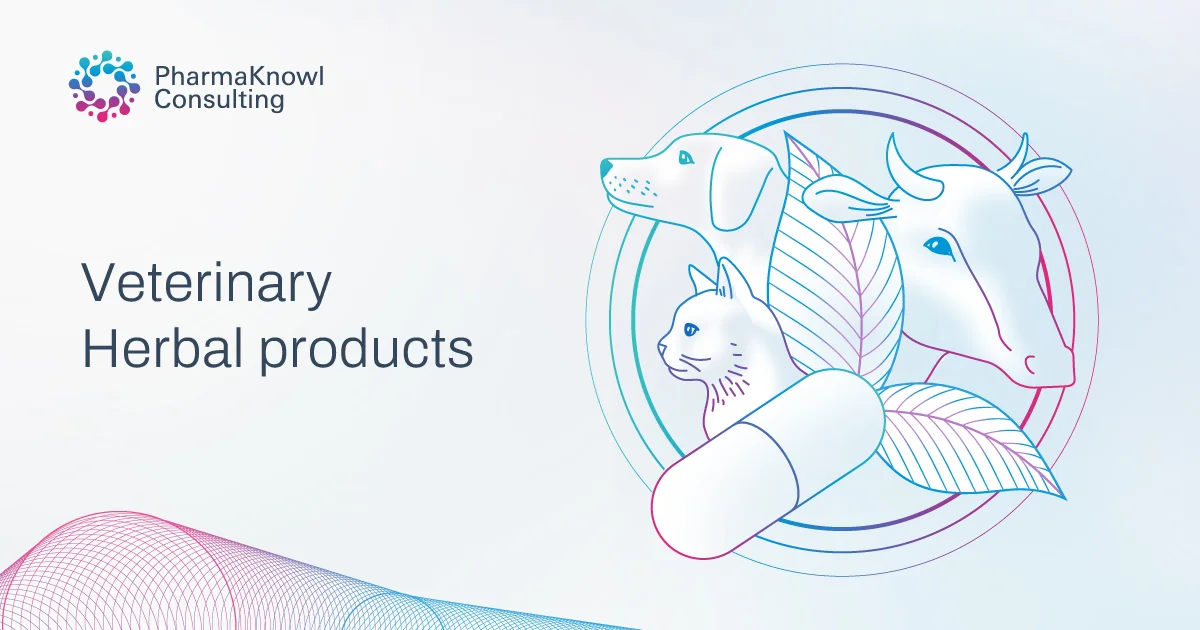
Herbal veterinary products are plant-based substances that treat or prevent animal health diseases. However, being herbal does not necessarily qualify a product as a medicinal product. For instance, if there is no therapeutic claim and only a trace of crushed or dried leaves is added to the animal’s feed will most likely be considered outside the scope of the SFDA requirements for drug registration of herbal products.
This article describes the requirements for the registration of veterinary herbal medicinal products in Saudi Arabia in easy terms and explains their classification. It also outlines factors for companies to consider when planning for submission to the SFDA.
Table of contents
Introduction
Herbal veterinary medicines, derived from plants or herbs, function similarly to conventional drugs, helping to address various animal health issues. If a product contains only purified or isolated chemicals from a plant, rather than the natural herbal material or extract, it is not classified as a herbal medicinal product.
Classification
There’s no official list of categories, but the SFDA often talks about these types:
| Product Type | How It’s Typically Defined |
|---|---|
| Generic Veterinary Medicines | These must show bioequivalence and have the same active components and pharmaceutical form as a reference product. |
| Similar Biological Veterinary Products | These biological veterinary products are comparable, but not identical, to an approved reference product. Additional information on safety, immunogenicity, and efficacy may be needed for approval. |
| Herbal Veterinary Medicines | These are medicines made from plants used to cure or prevent animal diseases. Claims must be supported by research or traditional use. |
It is recommended that the product’s classification be made in advance of registration, particularly for borderline products or herbal preparations. Classification determines which rules apply, the requirements, and the review process.
Herbal vs. Veterinary Drug Registration
| Parameter | Herbal Veterinary Products | Veterinary Drugs |
|---|---|---|
| Efficacy Evidence | Preclinical and clinical documentation or literature supporting risk-benefit balance, per SFDA guidelines | Full preclinical and clinical evidence or literature required |
| Safety Data | Limited toxicological information; may require residue studies for food-producing species | Detailed residue studies and toxicological studies are required |
| Quality Control | Focus on botanical identification and contaminant analysis. | Validated specifications for active pharmaceutical ingredients |
| Labeling Scope | Traditional or general health claims permitted (non-therapeutic) | Only approved therapeutic claims supported by data are allowed |
| Review Committees | Evaluated by both Herbal and Veterinary committees based on product nature | Primarily screened by the Veterinary Drug Committee |
Dossier Format and Key Modules
CTD Modules Overview
| Module | Key Content |
|---|---|
| Part 1 | Administrative Information, SPC and Product Literature, Critical Summaries (Quality, Safety & Residues, Efficacy). |
| Part 2 | Quality documentation, Manufacturing Method, Control of Starting Materials, Stability Tests, etc. |
| Part 3 | Safety data, Pharmacology, Toxicology studies |
| Part 4 | Preclinical and clinical data: Efficacy evidence and traditional use justification. |
When submitting herbal veterinary products, use the Common Technical Document (CTD) format or the Veterinary Electronic Non-eCTD Submission (vNeeS) format, just as for traditional veterinary drugs. Since these ingredients are of plant origin, Modules (Part1 and 3) require particular attention.
Module 1: Product and Administrative Information
Contains all administrative and product data required, such as:
- Application form and cover letter
- A current GMP certificate, Certificate of Pharmaceutical Product (CPP), Certificate of Suitability and Certificates of Analysis (CoAs) for:
- Active herbal constituents
- Excipients
- The finished product
- Summary of Product Characteristics (SPC) and a Patient Leaflet (PL), both English and Arabic, along with artworks and samples.
- Patent information and letter of access to Drug Master File (DMF).
- Pharmacovigilance reports and pricing information.
- Critical summaries related to quality, safety, residues, and efficacy.
Module 3: Safety and Residue Documentation
The main emphasis is placed on quality and safety documentation, especially for herbal ingredients, necessitating:
- Botanical identification of all raw materials, including scientific (Latin) names, the specific part of the plant utilized, and the place of growth or origin.
- Standardization processes that define how the herbal extracts are quantified and controlled, e.g., by establishing marker compounds and utilizing validated assay processes to guarantee uniformity from batch to batch.
- Contaminant analysis, which shall include:
- Toxic metals
- Pesticide residues and fumigation agents as per local and international safety specifications
- Mycotoxins such as aflatoxins, ochratoxin A.
- Radioactive contamination if it’s applicable.
- A step-by-step description of the manufacturing process shall include any in-process controls, together with the results of stability studies that validate the proposed shelf life of the product under defined storage conditions.
- The use of ethylene oxide is prohibited for the decontamination of herbal substances.
Considerations on Safety, Efficacy, and Residue
Although traditional use usually supports the use of herbal products, the SFDA requires applicants to provide sufficient scientific justification if a product is intended for animals that contribute to the food supply.
The application should include:
- Toxicological data are essential for herbs where safety concerns are raised or used in higher quantities. If the studies are not available, the applicant must clearly explain and support their application with scientific reasoning.
- Residue depletion studies are for food-producing animals, such as cattle, poultry, or sheep. Such studies must determine the period over which residues persist in tissues, thereby helping to define a proper withdrawal period before animal products can be marketed.
- Efficacy may be evidenced from scientific literature, historical documentation, or traditional veterinary use. Where the product is based on tradition-based claims. References of good standing or expert opinion may support this.
Stability Studies
The applicant should prove that the product maintains the same level of stability within its intended shelf life through physical and chemical testing and microbiological evaluations. All these tests were conducted under conditions that reflect the product’s actual storage environment.
Herbal products are different from normal chemical drugs because:
- They contain many natural compounds, not just one active ingredient, so you cannot test the stability of only one chemical; instead, you must check the whole herbal profile using Fingerprint chromatograms (HPLC/GC fingerprints), which do not significantly change over time.
- If a product contains more than one herbal substance, you should try to test each one; if that is not possible, justify it with relevant methods such as Physical tests, etc.
In short, SFDA requires full stability data proving that herbal veterinary products maintain their quality, fingerprint profile, and safety throughout shelf life, including after opening and under real storage conditions.
Registration Support
PharmaKnowl makes SFDA herbal veterinary drug registration easier. We handle everything from document preparation to proper labeling and compliance so you can run your business smoothly.
Contact us today to simplify your process.
About the Author

Contributed by the PharmaKnowl regulatory affairs team, based in Riyadh. Written and reviewed by our SFDA-experienced consultants.
Resources

Services
Events