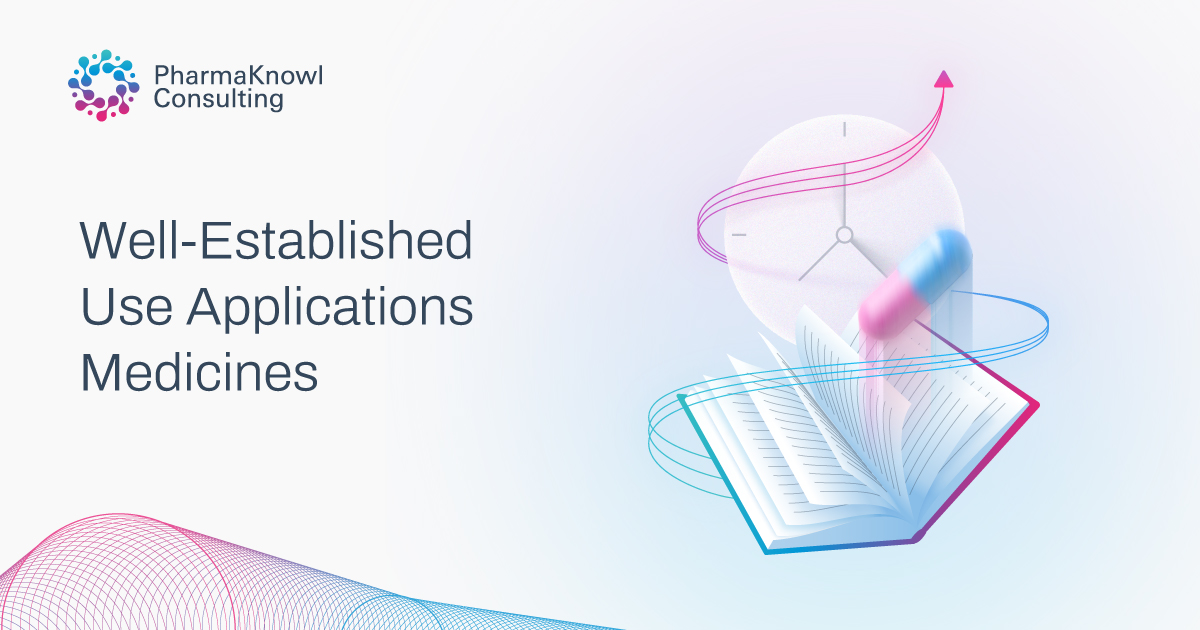
To help facilitate timely access to medicines, the SFDA provides alternative registration pathways and application types. One of these is the Well-Established Use (WEU) application, which may allow eligible medicinal products to support their marketing authorization application using published scientific literature meeting the eligible criteria with specific documentation requirements for Modules 1 to 3 and literature based scientific support for Modules 4 and 5.
In this article, we will discuss about the WEU applications, criteria, requirements and benefits for a pharmaceutical company and how to acquire registration with WEU application.
Table of Content
- What is WEU application?
- Criteria for WEU applications
- Benefits for a pharmaceutical company
- Requirements to Demonstrate Well-Established Medicinal Use
- How to acquire registration with WEU application?
What is WEU application?
For standard SFDA drug registration applications, applicants are generally required to submit extensive documentation to demonstrate the quality, safety and efficacy of the medicinal product. However, SFDA has introduced the Well-Established Use (WEU) application as an additional regulatory pathway for eligible medicinal products.
Under the WEU pathway, when an active substance has been used for more than 10 years in a Stringent Regulatory Authority (SRA) and its safety and efficacy are well established for the claimed therapeutic indication, the marketing authorization application may be based on published scientific literature.
This literature-based approach can reduce the need to generate or repeat certain non-clinical and clinical studies, potentially helping eligible applicants save time and resources during the registration and approval process. However, applicants must still meet SFDA’s specific documentation requirements, including the submission of Modules 1, 2, and 3, while Modules 4 and 5 require a detailed scientific bibliography addressing the relevant non-clinical and clinical characteristics.
Criteria for WEU applications
- The active substance must have been used for at least 10 years.
- The substance must have been used in a stringent regulatory authority.
- Its efficacy and safety must be well established for the claimed therapeutic indication with same dosage forms.
- SFDA considers factors including:
- The duration of use (not less than 10 years).
- The quantitative aspects of use of the substance.
- If the above criteria are met, the marketing authorization application may be based on published scientific literature rather than relying solely on newly generated clinical/non-clinical studies.
- The applicant must submit Modules 1, 2, and 3 according to SFDA’s requirements.
- A detailed scientific bibliography must address the relevant non-clinical and clinical characteristics.
Benefits for a pharmaceutical company
- Reduces the need to conduct or repeat certain non-clinical and clinical studies by leveraging existing scientific evidence.
- Helps pharmaceutical companies reduce development costs associated with generating new safety and efficacy data.
- May shorten the time and resources required to prepare and support an SFDA marketing authorization application.
- Allows companies to leverage published scientific literature and existing evidence for established active substances.
- Reduces unnecessary duplication of studies where safety and efficacy are already well established.
- Provides a potentially more efficient regulatory pathway for eligible established medicines entering the Saudi market.
- Enables pharmaceutical companies to focus development resources on areas where additional evidence is genuinely required.
Requirements to Demonstrate Well-Established Medicinal Use
Factors which must be considered to consider a well-established medicinal use of medicinal products are:
- The submitted documentation should comprehensively address the safety and efficacy of the product, supported by relevant literature, pre- and post-marketing studies, epidemiological data and comparative safety and efficacy studies. Both favourable and unfavourable evidence must be included and appropriately justified bibliographic references may serve as valid evidence of safety and efficacy.
- Any missing information must be identified and justified to demonstrate that an acceptable level of safety and efficacy can still be established despite the absence of certain studies.
- The time over which a substance has been used (must not be less than 10 years).
- Quantitative aspects of the use of the substance.
- The level of scientific interest in the use of the substance, as demonstrated by published scientific literature.
- The consistency of scientific assessments regarding the substance.
If a submission is incomplete or needs clarification, applicants should carefully review any literature-based queries and respond clearly, concisely and accurately, making sure the required data is included in the correct eCTD application. Meeting these requirements prevents unnecessary delays and supports better regulatory decisions.
How to acquire registration with WEU application?
Obtaining a registration certificate can be challenging without expert support and mistakes can lead to delays and repeated discrepancies. At Pharmaknowl, our qualified and experienced team works alongside you, offering professional guidance every step of the way. Contact us today or schedule a meeting.
About the Author

Contributed by the PharmaKnowl regulatory affairs team, based in Riyadh. Written and reviewed by our SFDA-experienced consultants.
Resources
Services
Events