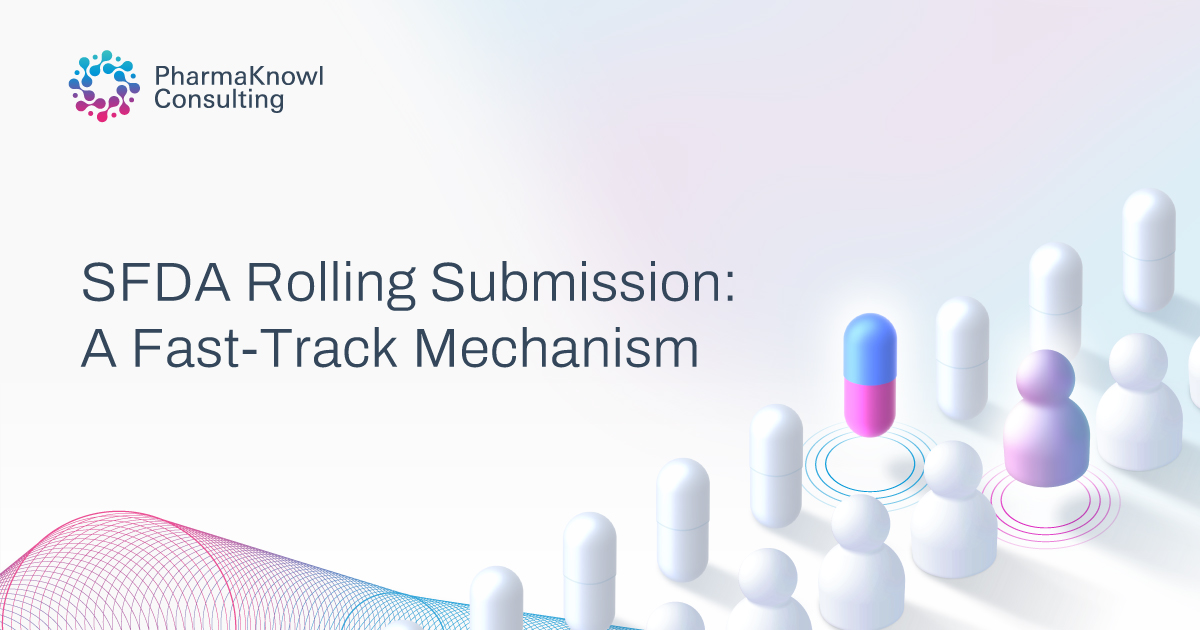
For drugs intended to treat serious or life-threatening diseases, the Saudi Food and Drug Authority (SFDA) allows marketing authorization holders (MAHs) to use multiple expedited pathways, including rolling submission, which is a fast-track mechanism under conditional approval.
In this article, we will discuss rolling submission in detail, including the criteria, process, how to prepare and submit the request, the benefits, and how to address the challenges companies face during rolling submissions.
Table of contents
SFDA Definition of Rolling Submissions?
SFDA defines rolling submissions as ad hoc procedures, meaning they are not routine pathways or mechanisms available automatically for every product. SFDA decides on a case-by-case basis, depending on the product and its requirements. This pathway is important for medicines with significant unmet medical need. This is not a standalone expedited pathway and is linked to the conditional approval pathway.
When is a Rolling Submission Applicable?
SFDA may allow applicants to submit a dossier in separate parts under the rolling submission mechanism. This approach differs from the standard drug registration procedure, where SFDA generally accepts and evaluates only a complete dossier.
- Applicants submit the prepared dossier modules.
- SFDA begins reviewing the submitted modules without waiting for the full dossier.
- When additional data become available, the company submits the next part of the dossier.
- SFDA then continues the review process based on the newly submitted information.
This staged approach helps maintain review momentum while the remaining data are still being finalized.
After submission of the request to SFDA, the authority will decide whether to proceed with the rolling submission. SFDA also encourages the applicants to present their development and submission plans for guidance and support throughout the process.
Differences
In standard submissions, SFDA mandates that applicants submit the entire dossier at once; however, if the company opts for rolling submission for conditional approval, then SFDA allows the applicant to submit the dossier in parts, which makes the applicant’s review process easier, as SFDA grants early review and communicates queries from time to time. With this mechanism, applicants have enough time to prepare other documents for the eCTD dossier modules and do not have to wait for long-lead items, such as clinical data and stability studies.
Challenges
Along with its benefits, rolling submission also presents certain challenges. One key challenge is that applicants may receive multiple queries with each submission, and they must address these queries within the specified timelines. SFDA may proceed with reviewing subsequent parts of the application only after the relevant queries have been adequately resolved.
Applicants should also keep in mind that rolling submission does not mean they can submit random documents or isolated pieces of information whenever they become available. SFDA generally expects submissions to be organized into complete, reviewable sections. In exceptional cases, SFDA may, at its discretion, accept a smaller subsection if it considers it to be a sufficiently complete and independently reviewable unit. This is a common challenge that companies often overlook, and it can slow the process.
How to proceed?
As a consulting company, we understand exactly what SFDA is likely to query. Our team of technical experts has extensive experience working with SFDA and has helped hundreds of companies like yours resolve these issues and expedite their registration process.
You can also contact us or schedule a free consultation call to learn more about the SFDA requirements and process.
About the Author

Contributed by the PharmaKnowl regulatory affairs team, based in Riyadh. Written and reviewed by our SFDA-experienced consultants.
Resources
Services
Events